
The Tree of Pain Life Cycle
Our life on this planet is infused with many wondrous experiences, which includes a multitude of variations of pain. Emotional pain becomes an exquisite teacher that can transform our limited human consciousness if the perspective of Divine Love is present.
But for the perception that does not include this point of view, well, pain just hurts. It has no purpose, no rhyme or reason. Emotional pain without Divine Love becomes extremely frustrating as it is repeated in a multitude of different shapes and sizes through the years.
Using the analogy of a seed growing into a tree, this section describes how a single painful event becomes embedded into our psyche and breeds behaviors that ultimately cause more pain. Existing unresolved pain quickens the growth of new emotional pain. Pain begets pain but love begets love. Emotional pain embodies itself in our human psyche, not within our spirit or Divine Love. Therefore, as Spiritual Archaeologists, we appeal to our spiritual nature for resolve instead of the limited perception of our intellect.
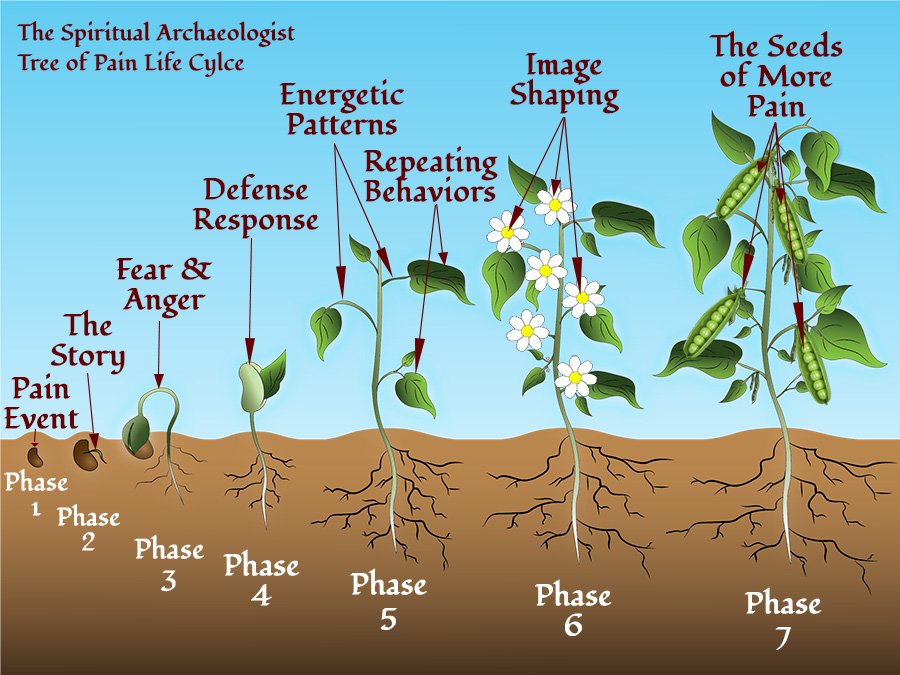
Phase 1: A Painful Event
It begins when one of life’s painful events crosses our path. Normally, we don’t even see it coming and therefore it can be a shock to our brain. Our mind and body react by recoiling or freezing up in these first moments because, for the most part, we dislike emotional pain.
When any painful event occurs, because it was not what we desired, it spawns another type of pain so common that for most, it becomes unrecognizable as pain. It is the pain of loss of not getting what we think will fulfill us in some fashion.
At this phase, pain in its raw form just hurts.
Do not let the sun go down on your pain.
This is our very first opportunity to resolve the pain before its energy takes root and creates something else. If we could stay with our raw emotions before we create the story, it would dissolve. If we have prepared ourselves to see from Divine Love’s eyes then the pain won’t take root. The story we create would then include love and eradicate the pain.
Phase 2: The Story
The story is almost immediately formed based on the nature of our reaction, our limited perception and previously unresolved pain. If our story lacks the energy of Divine Love perspective, the seed of pain is watered, causing roots to sprout into the soil of our psyche.
At this phase, the formation of a new layer of pain begins and is piled on top of preexisting layers. Prior to this phase, raw pain is simply part of our existence on the earth.
Pain, in its raw form is neither good or bad, it simply exists. The energy of pain always remains neutral. It is during The Story Phase where our limited false perceptions turn the neutral energy of pain into emotional suffering.
We write the story based on the sum total of all that is within our human consciousness at the time of the event. Then as time goes on we usually embellish our story and even alter the original version.
Make no mistake, that even if someone treats us in a hurtful manner based on their own pain, it is we who formulate the story that allows the emotional pain to become an ongoing part of our life. It should be obvious to us, but when pain is involved, we become blinded.
Two things we usually overlook: first, anyone causing pain is in pain. Second, we have caused someone else pain in one form or another because of the pain that is in us as well.
It’s hard to experience what we’ve done to others.
This is our second opportunity to resolve the pain. By clearing layers of pain over time through practicing The Dig, we begin to see through the eyes of Divine Love. Compassion and genuine love emerge towards others and change the stories we create in the future.
But until we are cleared of all our layers, we are enslaved to the paradigm of creating stories about our painful events. The flip side is, as our layers are removed, we are no longer bound to the energy of pain and false perceptions. Since we are the creators of our own stories, we hold the power to rewrite the script to include love.
Phase 3: Fear And Anger
Even the tiniest of roots causes fear and anger to sprout into existence, like energy designed to create a defense system around the original seed of pain. This happens very quickly, sometimes in the blink of an eye. Pain has now taken root and is building its defenses by deflecting the focus outward through fear and/or anger towards the exterior cause of the pain. Pain has now won over our minds and has begun to rally our conscious support to focus outside ourselves, away from the discomfort of our pain.
Fear is the anticipation of pain
Fear of touching our pain is automatically created as our first line of defense. It heightens our sensitivity to pain’s existence and begins to extend outward into the world, protecting itself from the possibility of similar pain. We may find ourselves becoming cautious towards circumstances that appear similar or have the ability to touch our pain.
From the perspective that fear is a response emotion rather than a root one, if we focus on the fear we miss the root cause and are bound to spend our days trying to manage our fear. The focus of fear is primarily internal.
Anger is pain’s revenge
Anger forcefully turns away from the pain and focuses outward as it fixates on an object, usually the source of the painful event. The energy of anger requires an outlet; it cannot remain calm or stagnant for it is the antithesis of peace. Anger must control; it is a part of its inherent energetic nature and when that is threatened, it exerts itself more forcefully. Responding to any of life’s situations with outbursts of anger simply means we are in great pain just below the surface.
When we see people’s fearful or hurtful behaviors not as their true selves but rather as symptoms of energy systems derived from pain, then compassion grows and we are genuinely able to help them because the energy of love is instinctively known to not be a threat. If we look at anger as a conduit for the energy of pain to express itself, we see how it uses us to escape into the world to propagate more pain. The release of this energy to cause pain within another becomes very satisfying. Angry people feel a sense of relief after an argument, fight or outburst like relieving the pressure of an abscessed tooth.
Divine Love casts out all fear
When our anger is revealed to us within the energy of unconditional love, we find our way back to the pain and usually end up in tears. Even for the most hardened of persons, they begin to remember love. This is the experience of so many on our planet, but not enough yet to stop the drama and violence.
If we focus on anger’s behavior, we never eradicate the root. Squelching the expression of anger without removing the pain causes us to implode. Anger will always find an outlet in some way, shape or form and its fruit is to spread more pain, even if it’s toward ourselves. Anger’s behaviors have been labeled destructive and rightly so, but they are symptoms of emotional pain. To stop a weed from growing, the roots must be removed.
If we look at fear and anger as energy systems born out of pain rather than psychological concepts or emotions, we will be lead to the reason for our behaviors. If we are led back to the pain itself, even if we don’t revisit the specifics, we have the ability to re-frame the story to include the energy of love.
Fear and anger cannot sprout within the energy of love
This is our third opportunity to stop the growth of the pain tree, yet with strong anger it is a bit more difficult. The Dig is designed to allow the next layer of pain, closest to the surface, to be revealed to us within the embrace of compassion and unconditional love. In that way we are able to move through the pain as in removing a thorn. Experiencing momentary pain in order to remove a thorn is very relieving.
Phase 4: Defense Response
Now that fear and anger have emerged as energetic systems within our psyche, they are still raw potential. Phase 4 is where they begin to take shape within our consciousness as thoughts and feelings. We might think something like, “That’s the last time I’ll trust my heart with someone.” No outward actions have yet emerged, but the patterns of defense in the form of thoughts and feelings are being constructed.
If we had no further thoughts or feelings about the event, no emotional baggage would materialize. You see, it’s not the event itself that causes prolonged damage but our response to it. At this point, we either become like the rock, sand or water. When a rock is hit with a stick, the rock breaks the stick. When the sand is gouged by the stick, a scar remains in the sand. When the water is thrashed by the stick, no evidence of the stick remains.
As most of us are like the sand, our emotional scars remain and become integrated into the landscape of our lives. If we continue past this phase, we will most assuredly shroud our wounds with the nice-looking hedges or beautiful flowers of our choice and learn to live with our pain. Expressing our pain through hurtful behaviors may even become a primary motivation for living.
In Phase 4, the growing energy of pain desiring to escape becomes very powerful and consuming. Pain hurts and cannot remain stagnant inside; it either needs to be resolved or redirected. Most of us allow it to be redirected rather than completely resolved. Replaying the event over and over in our minds helps to justify and crystallize the rise of our defensive system. Whether minutes or days pass during these moments is irrelevant. The energy must build to the point of finding which direction it will flow. The energy may build internally to implode back on to the person or outward towards an external object. This is how the energy can begin to breed more pain.
Once the energy begins to flow, we become unable to see ourselves with clarity because confusion sets in. We become incapable of realizing our lives are moving down the path of pain. We have become engulfed by our pain that knows only the satisfaction of birthing more pain. Even as this is discussed, it is so difficult to see if we are in pain.
To stop pain, return to love
This is our fourth opportunity to change the path of pain and possibly the last stop before the energy systems quicken to become the foundation of cradling our pain as a part of our daily life. After this we simply will not want to stop the growth of the Tree of Pain until it has either wreaked havoc on our lives or there is some form of spiritual awakening.
However, if we are prepared and allow Divine Love to show us how to take the path of love and peace, we can turn the growth of pain into the growth of love.
Phase 5: Energetic Patterns Breed Behaviors
Having now made the unconscious decision whether to implode or explode, pain begins the specific formation of energetic patterns that will establish its course of direction toward behaviors. There are a thousand possibilities, but embedded within our energy system exists a particular flavor tailored to our personality that will govern the types of behaviors that will truly satisfy us.
Then there it is: a drink, a drug, sex, depression, a fight, an argument, a physical outlet, work… The list goes on because there are thousands of possibilities but the driving force is to achieve relief from the pain that twists in our gut. If one thing does not work, we look until we find something that does. We are relentless in this pursuit.
Exploding: The External Focus
This process requires our conscious participation because we must find something from our immediate environment to arc our energy toward, like electricity seeks an object to be grounded to. The energy of pain, fear and anger all mixed together now, must connect with something external in order for the release to happen. As soon as we find and interact with an object, our pain is expressed and the pressure is temporarily relieved.
If that interaction does not include the energy of satisfaction or pleasure, we will most likely continue our search for something that does. Pain makes us feel empty while pleasure is the immediate sensation of being filled in the moment. The energy derived from pleasure is such a powerful aphrodisiac to our brain that it produces an insatiable appetite for more. Pain and pleasure are wonderful bedfellows.
Once we find a behavior that satisfies both relief and pleasure, we are hooked and from our perspective now, it is what we want as we consciously choose the behavior. As such, we begin the formation of the recurring behaviors that will eventually reshape the neural pathways in our brain that transfer energy to create the cravings that turn into what we might call an addiction.
In our analogy of a tree, these energetic patterns are the branches that feed the leaves (behaviors). If we view these systems as conduits for energy, they are bi-directional. They also return energy derived from pleasure similar to how leaves feed the roots with energy through the process of photosynthesis.
Imploding – The Internal Focus
Less obvious than exploding, the imploding process does not want the energy to escape but finds ways to keep it internalized, allowing it to strengthen. In this case, fear is better suited than anger because it allows the defensive formation of boundaries that trap the pain inside. These boundaries are formed in ways that suits our personality best.
The pleasure can come from the pain body itself and be held inside us through fear, the fear of exposing the pain or letting it escape. In this case, outside looking in, we would tend to see more fear than anger. If we focus on the fear, we once again are dealing with the symptom rather than the root cause.
Imploding pain is happy to find external objects if the primary focus returns back into itself. Since drugs or alcohol are brought into the internal reality, they are well designed for imploding as a method of both relief and pleasure. One can spend decades inside such a bubble, minimizing external interaction until the day when the bubble bursts.
We are capable of having aspects of both exploding and imploding at the same time. It is not necessarily one or the other and can fluctuate depending upon many factors. But if we view pain as energy, we can concede that it must go somewhere, into itself or outside to others.
The internal focus finds pleasure differently than the externally focused pain. Self inflicted pain breeds itself by taking pain back into the body, whether by its own hand or allowing it to come through someone else. It will search out people or situations and instead of looking to express pain on to another, it will look toward receiving pain.
The external focus gives pain,
the internal focus receives pain.
Put the two together for a perfect match.
The conscious mind may need to learn how to turn itself off in order to accomplish this in certain venues. Internally, new pain becomes a form of both the release of pain and the pleasure derived from new pain.
This focus can take so many different outward forms within our world that if we look only at the surface of a person’s life without following the energy of pain, we will miss how pain is feeding itself through using others or situations as a way to create new pain. Basically, if you would please hurt me in some way, it would feel pleasurable to me.
This is our fifth opportunity to stop the growth but in reality, we don’t want to at this point. We see no reason to and will usually ignore all the red flags. The force driving the behaviors is overwhelming and talk has very little effect. And yet there does exist the possibility of arresting the growth of the pain tree, but it will take at least an equal and opposite force and the conscious willingness on our part because we willingly allow it to exist.
Phase 6: Shaping Our Image
At this Phase we are in pain and have been acting out in a way that has changed our lives, usually for the worst. The people closest to us have noticed that something is off, but may not know what or why. They approach and we deny by stating nothing is wrong or give a false, yet seemingly valid reason for our change in demeanor.
We blame the event and the people involved, taking the posture of a victim. Fear and anger have emerged in our heart, even if we miss the person we were prior to the event, we simply don’t know how to return. We may incorrectly think we are scarred for life. We begin to think that this is who we are now and, from a limited perspective, we are correct. Without an expanded perspective we usually remain in this condition for some time or even the rest of our lives. However, we generally leave out one very important fact, that the pain is not who we are but something that has come upon us like a foreign object and we simply reacted to it.
In response to our condition, we begin to sprout the flowers of the Tree of Pain that will represent our newly modified self-image. Our tailored image will be of our own making based on our personality and desires. We may choose to flaunt our pain through anger by blatantly inflicting pain toward others without signs of remorse or the opposite by immersing ourselves into a spiritual program and be perceived as a wonderful person. We may opt to become highly motivated to achieve financial success in order to build a hedge around ourselves and think money will protect us from our pain.
We put on the garments that will cover our pain and make us appear in the fashion we want to be seen. Some might call it a mask and there are as many variations of this mask as there are people on the earth. However, the generalities of masks are similar enough that we have even categorized them into names and attributes. As birds of a feather flock together, so we also congregate according to our masks.
For instance, if we have pain regarding someone not liking us because of the way we look, then our response may be to embellish our looks so as to become more attractive. To be clear, the issue is not what we do, but “why” we do it. One person can beautify themselves for the sake of beauty while another is doing it in response to pain. It is completely individual.
This is our sixth opportunity to recognize the growth of the Tree of Pain, but now that the attributes we consider attractive have blossomed, almost all of our focus turns to the outward manifestations. We have ventured even farther from the pain source and begin to believe that growing our flowers bright enough will drown out anything lying below the surface. Our duality is complete, leaving only one more Phase.
Phase 7: Pain Begets Pain
This is the final phase of the Tree of Pain life cycle. Once a seed of pain is dropped into the world, the cycle repeats itself back at Phase 1. Each new seed adds another layer of pain on top of the others. Years go by and yet when exposed, we can trace individual pain all the way back to our childhoods. It should be clear to us as we get older that pain does not go away on its own but remains in us until we choose to let it go.
This is how our pain begins to diversify into different manifestations of the same root pain. Each new pain is formed based on our current conditions and state of mind. Our environment will certainly come into play as our pain attaches itself externally. This is why:
Wherever we go, there we are.
Our pain follows us into new environments and thus creates new circumstances. At first it may appear that we will be cured if we get rid of the objects of our pain. But time marches on as variations of circumstances manifest into our lives to become our current misery.
This is very common within programs of substance recovery where the primary focus is on the removal of the substance. Everyone agrees that until the substance is removed, beneficial personal growth will not take place. Then, identifying fears, anger and character defects followed up by making amends does clear up a person’s life to a degree. But unless there is a spiritual awakening of some sort that leads a person into transforming the pain into some level of love, the individual remains unhappy inside.
In time we notice the patterns in ourselves that others may have seen for awhile now, but until we see it in our heads, our minds simply will not admit that pain exists.
Talking about our problems without resolve can become part of the pathology that keeps pain alive. If we can talk about it, then it feels as if we are dealing with it. Please don’t misunderstand. Talking is great, but unless the pain is resolved, it keeps increasing over the years until keeping it alive wears us out. We become broken down in spirit and health.
This is generally how most people live regarding emotional pain. We wait for the birth of new instances of pain and attempt to modify our behavior so as not to reap the consequences. But it should make sense to us that at this phase, it’s like trying to hold back the tide.
This would be our seventh opportunity to change the Tree of Pain life cycle but at this phase, it is too late. We are already birthing new pain on a daily basis. We have become co-creators with pain to shape our reality through limited false perceptions. Our own human mind has become the problem and therefore it cannot fix itself. It will neither want to nor know how because confusion keeps it in darkness as it holds on to its malformed paradigm of life.
This is the way for all of us, to one degree or another. By comparing ourselves to others, we will use the people worse off than us as a way to appear better off than we truly are.
But comparing ourselves to Divine Love causes the perspective of ourselves to include the disparity between our version of love and that of Divine Love. If our heart’s reaction to this is to be drawn toward Divine Love, then we become willing to allow this love to remove everything that hinders. The inescapable outcome is the process of becoming the love we seek.
We have become co-creators with pain. The way out is to invite the unconditional love from our soul into our pain.